Technological maturity on human capital
HR data in.
Investment case out.
Temmio turns the data you already have into a maturity score, finished investment cases and documented effect. In money, not gut feeling.
For HR and operations · consultants
Built on research: 28 interviews across 15 Danish organisations · Aarhus BSS · Winner of Civilingeniørprisen 2026
Investment case
Nordvang A/S
The biggest budget line is run on gut feeling
Machines get service plans, depreciation profiles and business cases. People get an engagement survey and a hunch. Yet for most organisations, people are the single largest cost.
The consequence: initiatives on retention, absence and skills compete for budget without numbers behind them. And without numbers, they lose.
"It is assessed on vibes and manager intuition."
HR lead at a Danish law firm, research interview 2026
Why is it like this?
The asymmetry
"It runs on gut feeling and the mood of the organisation, not on dashboards or reports."
HR lead at a Danish operations organisation
The category error
"Wellbeing initiatives are treated as soft programmes meant to lift morale a little, not as strategically integrated investments."
Company founder and board member
Responsibility without numbers
"HR are typically the last to join the strategic discussions. They are not seen as creators of strategic insight."
Board member at several Danish companies
From 28 research interviews across 15 Danish organisations (Aarhus BSS), field notes
A Danish company, 200 employees
Absence 5.0% · Turnover 30% · Avg. salary DKK 35,000/mo · Recruitment and training per departure DKK 300k
And that is only the direct bill. This money sits at zero return: put to work in the business, the amount would typically multiply by 1.5 to 2 in lost opportunity, in highly specialised industries 2 to 3.
The product's model: daily wage = monthly salary/22, 264 working days per year; turnover = 200 × 30% × DKK 300k.
Three things you get out of your own data
Board-ready documents
Eleven templates, from sales pitch and status sheet to ESG pack, board meeting and annual report. Over 30 sections to toggle on and off, with graphs, tables or key figures, simple or advanced.
Investment case
Not a template you fill in yourself. A finished document with expected savings, payback and assumptions in place, formatted for the room it enters.
Documented effect
Effect measured against comparable teams with honest confidence. If the data is not enough, we say so.
What it looks like
The overview shows your teams side by side: where the money leaks, against your industry benchmark. And the document builder turns it into reports and presentations ready for the boardroom.
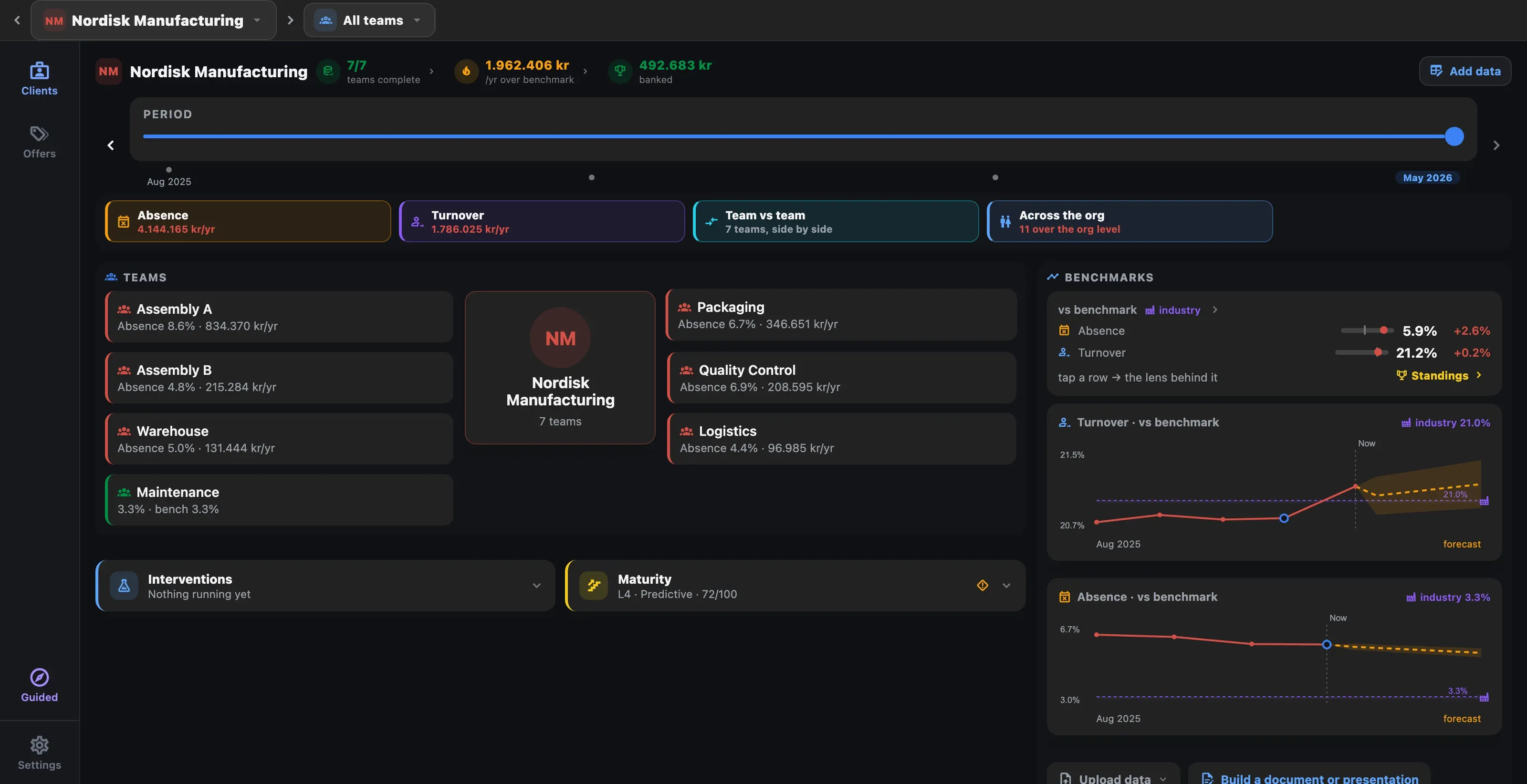
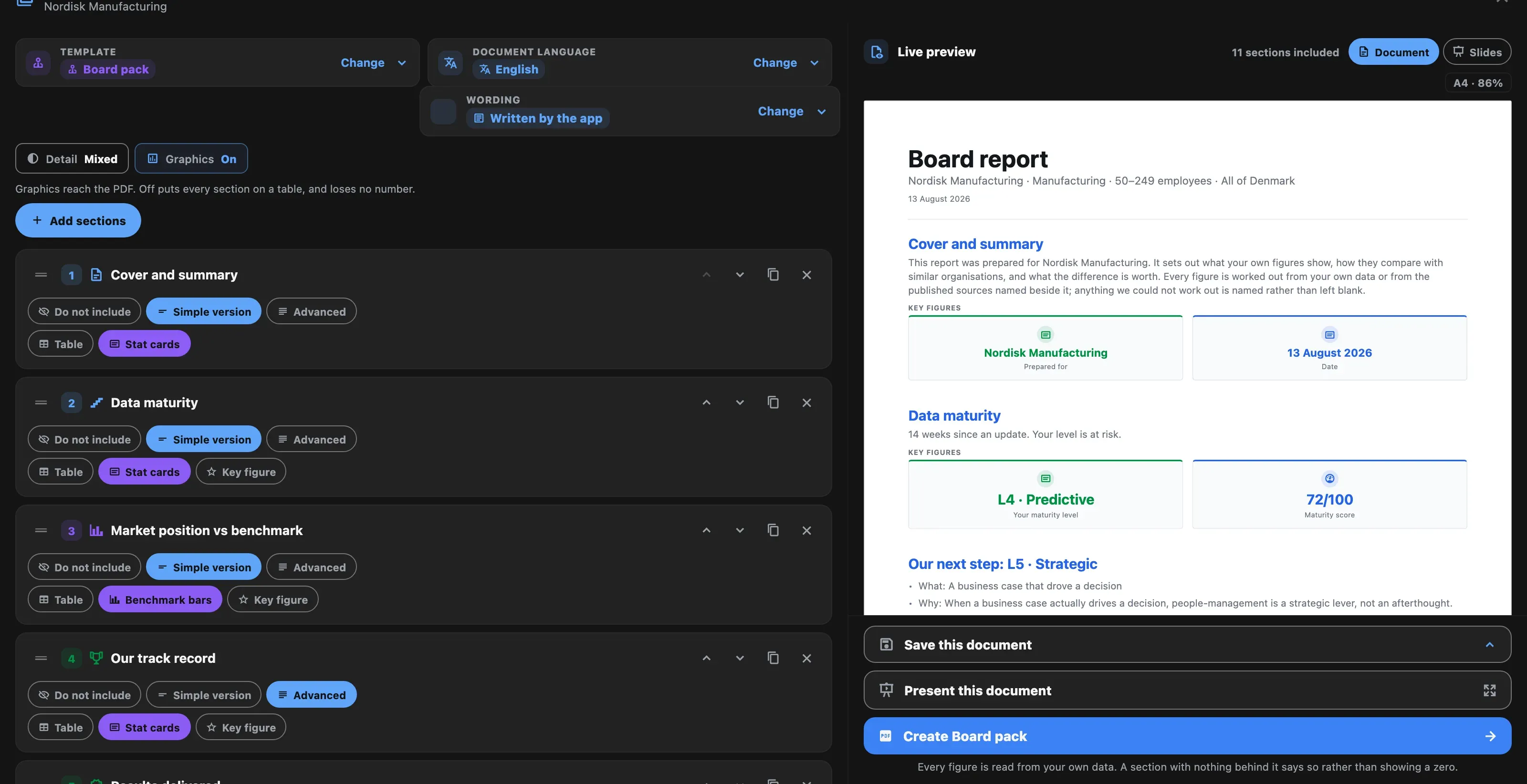
Opens the product in your browser. No login, no real data; the sandbox clears itself.
"Absence is down 1.4 percentage points. And we are 95% sure it is not a coincidence."
HR could never say that sentence before. Here is how it is built: measured against a control group, with an honest confidence interval.
How do we know it was the initiative? See the answer →Two ways in
For HR and operations
Win the budget conversation
See where the money leaks, against your industry benchmark. Bring leadership a finished case instead of a hunch.
How it works →For consultants
Sell with numbers. Prove with numbers.
Open the door with a quantified diagnosis of the client's absence and turnover. Close the next sale with documented effect from the last one.
For consultants →Give HR the same levers as the rest of the executive team
CEOs, CFOs and boards are themselves measured on numbers. To approve an HR initiative, they must be able to defend the decision upward, and that takes financial and statistical analysis, not a hunch.
That is why Temmio is not about proving that one single initiative worked. It is about making data an integrated part of HR work: quantitative evaluation in the repertoire and a direct channel to the top. Numbers give HR the same levers as every other department. That is what a seat at the table is made of.
Numbers that survive a boardroom
Every number on screen can be defended: benchmarks from Statistics Denmark, effect measured against comparable teams, and confidence that says honestly how sure we are. No individuals are ever measured.
What does absence cost you?
A quick estimate with your own numbers, against the national average. The maths happens in your browser; nothing is sent anywhere.
National average: 9.7 sick days
Estimated direct salary cost of absence
–
Direct salary cost only, with daily wage as monthly salary divided by 22. Cover staff, overtime and lost output come on top.
Built on research, not pitch decks
Temmio grew out of a research project at Aarhus BSS: 28 interviews across 15 Danish organisations on why decisions about people never get the same financial discipline as decisions about machines.
Among the first development partners: Kompetencelab and a Danish industrial company.

Alex Skotner
Founder
Builds Temmio at the intersection of technology, organisational strategy and human capital. BSc in IT and MSc in technology-based business development.

Søren Lyck Jensen
Advisory board
More than 26 years of experience in technology, software development and system architecture, plus deep startup experience.

Karl Kristian Hansen
Advisory board
More than 33 years of experience in management consulting, executive search and strategic development. Co-founder of Hansen Toft A/S.

Mirko Presser
Research · Aarhus University
Professor at the Department of Business Development and Technology, Aarhus University. PhD specialised in Mobile Internet of Things.

Madalina Stoicovici Pop
Research · Aarhus University
Assistant Professor at the Department of Business Development and Technology, Aarhus University.
Questions we always get
How do you know it was the initiative and not something else?
We compare the teams that got the initiative with comparable teams that did not. The method is difference-in-differences: the control group shows what would have happened anyway, and the difference is the effect of the initiative. The result gets a 95% confidence interval, and with under a year of data we say so openly, because seasonal swings cannot be ruled out.
Do we have to know the numbers by heart if we start using them?
No. What counts is access to the numbers, not memory. A doctor looks things up too, and most CFOs have to recompute or look up their own internal figures. Spending 20 to 60 minutes of a meeting doing the arithmetic together is not a good use of anyone's time. "I will send you the calculation after the meeting" is a perfectly normal answer. In the research interviews behind Temmio, the demand to know figures by heart never came up; what people asked for was the formulas next to the numbers, so anyone in doubt could check the work.
Can you even measure people like that?
We do not measure people. We price outcomes that already sit in your systems: absence, turnover and payroll at team level. No measurements of individuals and no monitoring of behaviour.
Is this surveillance?
No. Everything is aggregated at team level, groups below the anonymity threshold are not shown at all, and individual scores do not exist in the product. See the employee page in the footer.
Our data is a mess. Can we still join?
Yes. Temmio starts with what you already have: payroll, absence rates and turnover per team. Data quality is shown openly in the product, and gaps are named in the reports instead of being filled with zeros.
Why put numbers on this at all?
Because the decisions are already made in numbers. CEOs, CFOs and boards must be able to defend a budget upward, and without financial and statistical analysis, HR initiatives lose to whoever has their numbers in order. The research behind Temmio shows assessment today runs on vibes and manager intuition. Without numbers, initiatives like these depend on leaders willing to take a risk on pure conviction, in themselves and their executive team. That exists, but modern organisations are not designed for that road, so it is the hard one to travel. With the numbers, the same passionate people can raise funding down the road that is already paved: the financial approval process. That frees more resources for similar initiatives and more time for everything else.
What if the result cannot be documented?
Then that is what it says. "Not enough data" and "preliminary" are possible answers, and a result without cover never enters a boardroom. One indefensible number would cost all the credibility.
What does it cost?
The first month is free, so you can see your own numbers before you decide. After that, a yearly licence per organisation, priced by size. Final price points are set together with the first development partners, and partners keep their terms. Write to alex@temmio.dk for a concrete price.
Help set the standard
Temmio currently works with selected organisations as development partners. Not as classic software customers, but as organisations that want to shape how human capital should be measured, prioritised and documented.
As a partner you get early access, close collaboration and decision material built on your own data.
The pricing model is simple: the first month is free, then a yearly licence per organisation, by size. Final price points are set together with the first partners; partners keep their terms.
See your own numbers instead of a pitch
Write, or call. We start from your data and your questions, not a demo of ours.